

Communication Session 09: Researching and discussing the effects and possible actions/solutions of your issue
Summary: The students learned more about formatting the Modern Language Association (MLA) Works Cited. Then, collaboratively, we made sure you understood the steps of the research process, how to narrow down a research topic, how to find reliable, solid research material, and how to take valuable notes.
Review of the Outline of Our Research Process:
- Basic Information
- Causes
- Further Examples or Case Studies
- Effects
- Solutions
Documents:
Quick Guide to Citing in MLA 9th Edition
“If you can’t explain it simply, you don’t understand it well enough.” ~Albert Einstein
MLA Note Taking Sample:
Wong, Yu, Hussey Freeland, Deborah M., and Kari C. Nadeau. “Food Allergy: Immune Mechanisms, Diagnosis and
Immunotherapy”, Nature Reviews Immunology 16, 31 October, 2016, pp. 751–765.
https://www.nature.com/articles/nri.2016.111
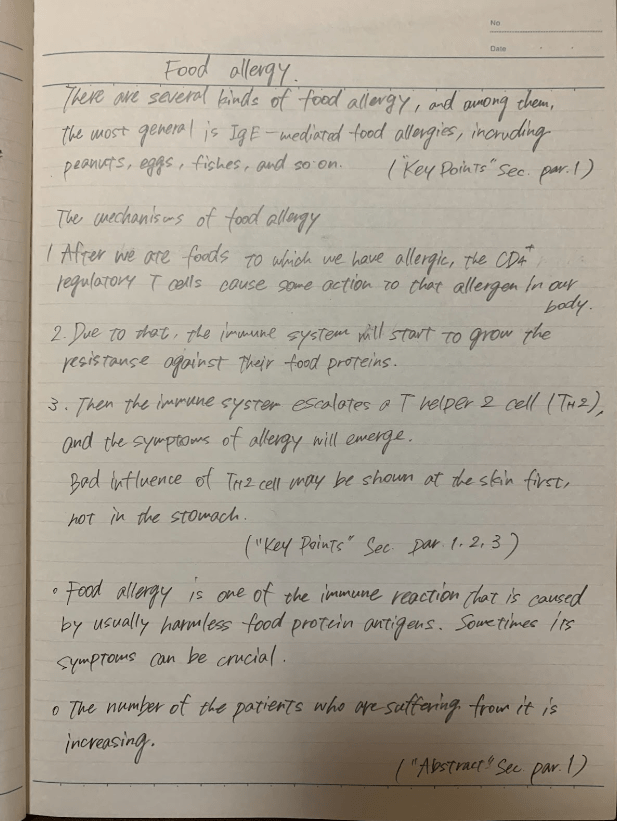
Homework is due by 1:00 p.m. the day before Communication Session_09. Please take photos of your notes and insert them in your shared online document under Research Articles #6 & #7. If you are behind, upload them to your shared online document. Then, your teacher can edit your MLA Works Cited if needed.
Free Database Engines for research on your MLA Presentation:

Carrot 2 Carrot helps you find topics related to your search term. After entering the term you enter and then clicking on ‘search,’ you can see the results as a list, treemap, or pie chart that helps you visualize your issue and narrow your search simultaneously.
CORE Research Engine UK: This research search engine claims to be the world’s largest open-access research database, offering free access.
Directory of Open Access Journals (DOAJ): DOAJ is a community-designed and maintained online journal directory that provides access to robust, open-access, peer-reviewed journals. This search engine is independent and free, including being indexed in DOAJ. Please use this engine for topical issues and authors; you might find research that supports your academic essay. DOAJ is an educational outreach search engine focusing on high-quality applications and submissions.
Google Scholar: Google Scholar helps you do a broad or narrow search of articles. It also lets you cite your “references” for APA and “works cited” for MLA!
JSTOR is a digital library of academic journals, books, and primary sources.
Learning About Global Issues—This explicitly relates to Chuo University Faculty of Law English courses and provides 18 core global issues. I got permission. Thank you, Chuo U, for the Sadai students.
Zenbird Media: Topics & Issues: Do you often think about researching issues related to your local community or Japan in general, but find the data in Japanese? Then, Zenbird Media is for you!
Pingback: Academic Communication Skills 1a & b -Wed. 2nd | Stacey Vye's English Education Homepage