

Workshop_07 MLA -The 1st Draft

Summary:
Homework due via email (Sending earlier than the deadline is great for quick feedback to you!):
Do WAVE for your essay before emailing your first MLA draft!
W = Put your paper through MLA Essay Write & Improve
V = Veritus Certify! Check against Plagiarism -Leander Hughes
E = Check all Explanations attachments, download “Instructions-for-MLA-Writing_AEW2,” and type your paper directly in the document. Once finished your draft, please email it to me.
“Explanations” Attachments:
Instructions-for-MLA-Writing_AEW2Download
AEW2__MLA-Midterm-Assessment-GuidelinesDownload
OWL-Purdue-MLA-9th_PPt-1Download
Student Sample MLA Paper on Brexit
MLA Sample Paper on Propaganda (Same as the Synthesized Notes Sample)
Due via email by 1 p.m. the day before class:
1. Please download the ‘MLA and Works Cited’ MS Word document attached below and type directly in the paper.
2. Using your ideas from the five questions you have made and the five articles you have taken notes on, write your essay. Please refer to the formatting guidelines and the MLA Sample Paper also attached below.
3. If you are referring to your readings and it is not your original idea, please do an in-text citation of the author’s last name and page or paragraph number like this (Suzuki 22) or (Tanaka par. 3) at the end of the sentence before the period.
4. Your paper needs to be typed with double-spaced lines, and at least 1,000 words but no more than 1,400, so please use the word count tool in Microsoft Word and type the word count number at the end of your paper before the Sources Cited section, like this:
Word Count: 1,335
5. Please make sure that your name, draft number, AEW course name, date, and title are in the attachment file like this:
‘Your Name’_AEW2_ Draft 1
An option to do Write & Improve practice essay:
Five improved essays are due by the end of the semester. You can choose the essays and the time of writing freely, but write and improve on no more than one essay each week.
Workshop_05: The MLA Academic Essay -Finalizing the Gathering of Your Research

Summary: We focused on editing the Works Cited entries from your notes. Then, the students communicated their issue development in pairs.
Outline of our Research Process:
- Basic Information -Wide reading
- Causes -Wide reading
- Further Examples or Case Studies – Close reading
- Effects -Close reading
- Solutions -Close reading
Alex Essay Writing Tool Step 09 -Write, repeat
Alex Essay Writing Tool Step 10 -Revising
Documents:
Quick Guide to Citing in MLA 9th Edition
“Take the attitude of a student, never be too big to ask questions, never know too much to learn something new.”
-Augustine Og Mandino
Homework is due on 12/18/2024 before class, please complete take notes and insert the photos for these research notes on Article #5.
MLA Note Sample:
Instructions for Homework Content:
1. Please, take your on article #5. Make it count, and the notes should be at least two pages with in-text citations, and upload them on your Google Doc.

Free Database Engines off Campus to collect research for your MLA Paper:

Carrot 2 Carrot helps you find topics related to your search term. After entering the term you enter and then click on ‘search,’ you can choose to see the results as a list, treemap, or pie chart that helps you visualize your issue and narrow your search at the same time.
Directory of Open Access Journals (DOAJ): DOAJ is a community-designed and maintained online journal directory that provides you access to robust, open access, peer-reviewed journals. This search engine is independent, and it is free including being indexed in DOAJ. Please use this engine for topical issues and authors, and you might find research that provides evidential content for your academic essay. DOAJ is an educational outreach search engine that focuses on high-quality applications and submissions.
Google Scholar: Google scholar helps you do a broad or narrow search of articles. It also helps you cite your “references” for APA and “work cited” for MLA!
CORE Research Engine UK: This research search engine claims to be the largest open-access research database in the world giving free access.
Learning About Global Issues–Specifically in relation to Chuo University Faculty of Law English courses, this website has been designed by Andy Barfield and his research team for supporting student research from 2014 in the Basic Research and Writing. More generally, his team hopes that this website is useful for students and other people in Japan (and in other countries) to develop our knowledge and critical understanding of different global issues. Thank you, Andy!
New! Zenbird Media: Topics & Issues: Do you often think about researching issues related to your local community, or Japan in general, but find the data in the Japanese language. Then, Zenbird Media is for you! They make a beautiful website for professors, so we can focus on giving students feedback rather than building websites.
Five improved essays are due by 01/31/2025. You can choose the essays and the time of writing freely, but write and improve on no more than one essay each week.
Session_09: The MLA Academic Essay – Summarizing Solutions and Conclusions

Summary: The students learned more about formatting the Modern Language Association (MLA) Works Cited. Then, collaboratively, we made sure you know more about the steps of the research process, the key terms of academic writing, narrowing down a research topic, finding reliable and solid research material, and taking valuable notes. We also carefully considered and followed the activities of the Alex Essay Writing Tool, with steps 7 – 8, to focus on your close reading.
Review of the Outline of our Research Process:
- Basic Information -Wide reading
- Causes -Wide reading
- Further Examples or Case Studies – Close reading
- Effects -Close reading
- Solutions -Close reading
Documents:
Quick Guide to Citing in MLA 9th Edition
“If you steal from one author it’s plagiarism; if you steal from many it’s research.”
Wilson Mizner
Alex Essay Writing Tool Step 07: Close reading
Alex Essay Writing Tool Step 08: Give your material order
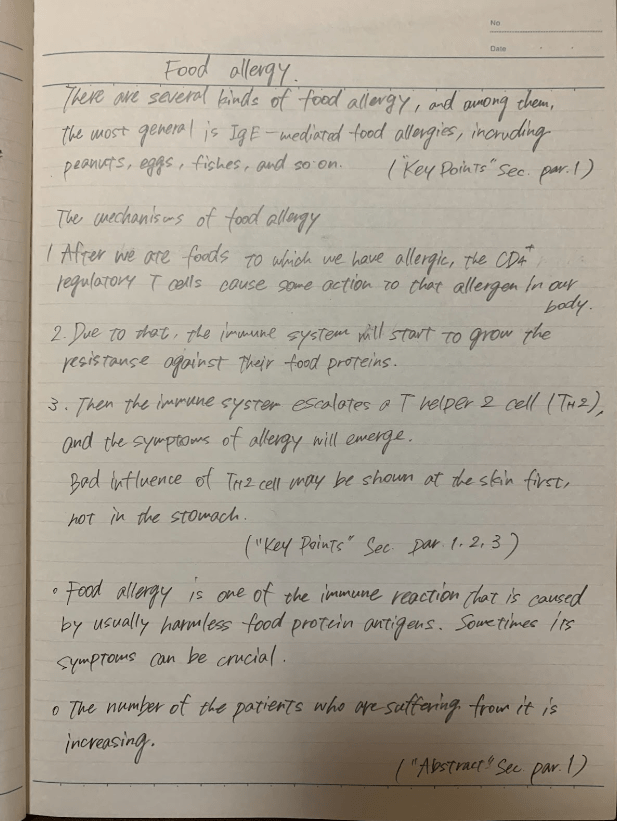
MLA Note Taking Sample:
Wong, Yu, Hussey Freeland, Deborah M., and Kari C. Nadeau. “Food Allergy: Immune Mechanisms, Diagnosis and
Immunotherapy”, Nature Reviews Immunology 16, 31 October, 2016, pp. 751–765.
https://www.nature.com/articles/nri.2016.111
Homework is due by 1:00 p.m. the day before Session_09. Please take photos of your notes and insert them in your shared online document under Research Articles #6 & #7. If you are behind, upload them to your shared online document. Then, your teacher can edit your MLA Works Cited if needed.
How to Find an Issue to Research
Free Database Engines for research on your MLA Paper:
Carrot 2 Carrot helps you find topics related to your search term. After entering the term you enter and then click on ‘search,’ you can see the results as a list, treemap, or pie chart that helps you visualize your issue and narrow your search simultaneously.
Directory of Open Access Journals (DOAJ): DOAJ is a community-designed and maintained online journal directory that provides access to robust, open-access, peer-reviewed journals. This search engine is independent and free, including being indexed in DOAJ. Please use this engine for topical issues and authors; you might find research that provides evidence for your academic essay. DOAJ is an educational outreach search engine focusing on high-quality applications and submissions.
Google Scholar: Google Scholar helps you do a broad or narrow search of articles. It also lets you cite your “references” for APA and “works cited” for MLA!
CORE Research Engine UK: This research search engine claims to be the largest open-access research database in the world, giving free access.
Learning About Global Issues—This explicitly relates to Chuo University Faculty of Law English courses and provides 18 core global issues. I got permission. Thank you, Chuo U, for the Sadai students.
Zenbird Media: Topics & Issues: Do you often think about researching issues related to your local community, or Japan in general, but find the data in the Japanese language? Then, Zenbird Media is for you!
ICR Class 11: Cycle 2 sharing news stories & graded reader 8

Summary:
When you have time this week, please write reflections in your Google Doc. to think about your English learning progress. The questions are:
1. How did you participate in class today? Please describe as best you can.
2. What did you learn about your issue? Your speaking pairs issues?
3. What are your next SMART (simple, manageable, attainable, reasonable, timely) learning goals?
Homework due uploaded to your Google Drive Shared file by Friday at 1 p.m. before Class 12, who are not presenting: Please upload the pictures of your notes in your Shared Google file under the section “第 10回 Cycle 2 Sharing News Stories & Graded Readers 8.”
Presenters’ Homework for Class 12 due by Sunday, 5 p.m.:
1. Choose the best graded reader that you have already taken notes on to make your Super Book Talk presentation.
2. Review these loose Super Book Talk Guidelines. The goals are to:
-Do the Super Book Talk task
-Use a variety of sentences with some challenging vocabulary summarized by you
-Use of relevant and accurate details that show you read the book
-Demonstrate a complete understanding of the book you read
-Make inferences (guessing about the text) from the book and have a clear focus
-Easy to listen to with a sense of voice and explore the acting of characters’ voices.
3. Digital sharing is best like PowerPoint, Google Slides, or Prezzie.
4. Please email me with your attachment, or put your file in our shared Google file, and I will be notified.
5. There are some examples of Super Book Talk presentations from another university.
6. Please do not copy/paste the words from the book. It is better to summarize as best you can in your own words. However, if there are some really cool phrases or sentences from the book you would like to share, please use “quotation marks.”
8. The title of the book, the author’s name, and your name need to be included.
9. Usually, each Super Book talk should last five to seven minutes, with time for questions and answers from the audience.
10. Also, could you remember to make a thank you, question, and answer page at the end.
And here are the ICR links and docs for your homework below for your convenience:
Different Ways of Listening 英語の説明
Downloading and Reading e-books: Maruzen eBook Downloading Service
第 11回 Cycle 4 sharing research notes 4: Possible actions & solutions -12/05/2022

Summary: You discussed in pairs the possible actions and solutions to your issue. Then, we discussed ways to prepare for your Cycle 4 presentations on December 12th or December 19th. Finally, you reflected on the three questions in your Google Doc.
Presentation Content and Design in case you need to present on Zoom due to COVID-19:
Stratvert, K. (2020, July 24). How to properly present PowerPoint slides in Zoom [Video]. Youtube. https://www.youtube.com/watch?v=wNOZRa089-U
I recommend before you start to create your slideshow restate your five research questions based the five sections below and then catagorize your notes based on your references:
- Basic Information
- Causes
- Cases or Further Examples
- Effects
- Solutions


Summary: Guidelines for your Presentation in addition to the information in the presentation of your issue document:
1. Your talk should be about 7-8 minutes and then 2-3 minutes for questions, comments, and answers.
2. It is good to practice your presentation several times (even recorded on ZOOM) so you can focus with your timing and gain confidence.
3. There are usually 12 to 16 slides.
4. You’ll have a References or Works Cited page to show where you got your work from. Please include the author’s name, date published, the organization or publisher, and the URL link.
5. In the slideshow, please write and say where you got the information from in the form of in-text citations for APA such as (Miller, 2020, para. 3). You can also do narrative in-text citations such as Suzuki (2020, p. 5) suggested that… If you use the author’s exact words, you need to use “quotation marks,” but you do not need quotes if you summarize the keywords. For MLA it would be Suzuki (5) or (Miller par. 3).
6. Here are three free websites where you can download free and beautiful images and pictures:
7. Samples of Chuo Students’ IRD PowerPoint Presentations
Homework due on Friday, 12/09/2022 or 12/16/2022 by 3 PM Cycle 4 pair and small-group presentations (Assigned on Class 11) Please email your presentation to me via attachment and not in your Google Document due to formatting. Please look for the email I will send you with feedback on your presentation.
Workshop_04 The MLA Academic Essay: The Effects

Summary: Students discussed their research with two sets of pairs and edited their notes and MLA Works Cited.
Documents:
Quick Guide to Citing in MLA 9th Edition
“If you steal from one author it’s plagiarism; if you steal from many it’s research.”
Wilson Mizner
Homework is due by 1 p.m. the day before Workshop_05. Please take photos of your notes and insert them into the Google document provided for Workshop 4. Other students can see your work and share it.
Instructions for Homework Content:
1. Please, research the SAME research issue using 2 Internet, book, newspaper, or journal articles about a topic that you are passionate about writing. These are notes on Articles #7 and #8. Then, take two pages of notes for each article using the keywords on the pages. Remember to write the author’s name(s), the date, and page or paragraph numbers if you use direct quotations. Try to summarize your work. Please type your MLA Work Cited so I can edit them.
Free Database Engines off Campus to collect research for your MLA Paper:
Carrot 2 Carrot helps you find topics related to your search term. After entering the term you enter and then click on ‘search,’ you can see the results as a list, treemap, or pie chart that helps you visualize your issue and narrow your search simultaneously.
Directory of Open Access Journals (DOAJ): DOAJ is a community-designed and maintained online journal directory that provides access to robust, open-access, peer-reviewed journals. This search engine is independent and free, including being indexed in DOAJ. Please use this engine for topical issues and authors; you might find research that provides evidence for your academic essay. DOAJ is an educational outreach search engine focusing on high-quality applications and submissions.
Google Scholar: Google Scholar helps you do a broad or narrow search of articles. It also enables you to cite your “references” for APA and “works cited” for MLA!
CORE Research Engine UK: This research search engine claims to be the largest open-access research database in the world giving free access to 1-This website is very informative and easy to understand, where you might find research on your issue from Professor Andy Barfield:
Learning About Global Issues–Specifically about Chuo University Faculty of Law English courses, this website has been designed by Andy Barfield and his research team to support student research in the Basic Research and Writing. More generally, his team hopes that this website will help students and people in Japan (and other countries) develop their knowledge and critical understanding of different global issues. Thank you, Andy!
Zenbird Media: Topics & Issues: Do you often think about researching issues related to your local community, or Japan in general, but find the data in the Japanese language. Then, Zenbird Media is for you!
2. An option to work on a Write & Improve practice essay:
Five improved essays are due by the end of the Semester. You can choose the essays and the time of writing freely, but write and improve on no more than one essay each week.
ICR Class 10: Cycle 2 sharing news stories & graded reader 6: paraphrasing

When you have time this week, please write reflections in your Google Doc. to think about your English learning progress. The questions are:
1. How did you participate in class today? Please describe as best you can.
2. What did you learn about your issue? Your speaking pairs issues?
3. What are your next SMART (simple, manageable, attainable, reasonable, timely) learning goals?
Homework due uploaded to your Google Drive Shared file by Friday before Class 11 at 1 p.m.: Please upload the pictures of your notes in your Shared Google file under the section “第 10回 Cycle 2 Sharing News Stories & Graded Readers 6.”
In the Spring Semester, you do out-of-class listening (10 times, about two pages each time) and read and talk about a minimum of 8 graded readers from the Chuo Library’s Maruzen eBook Library of graded readers. Please see the links and instructions below. The main thing is to do some homework in every class. You can do it little by little at your own pace.
By note-taking, please feel free to use charts, diagrams, and colors as you like. Then, can you take pictures of them and put them in your shared drive file with me?
The Steps for the Graded Readers in The Maruzen eBook Library “6 Spring Semester: Downloading and reading e-books” in the links above and below are very important to follow. Please download your book quickly and save it because we can only download one book at Chuo University at a time.
You can also read online here, and one with old-fashioned hard copies of the books:
- The online selection of stories at A2 level (for pre-intermediate students) in the Reading Zone on the British Council website for ICR students: https://learnenglishteens.britishcouncil.org/study-break/graded-reading/a2-graded-reading
- Series also in the Maruzen eBooks Library
- Macmillan Readers – Starter & Beginner levels
- Cengage Page Turners – levels 2, 3, 4 & 5
- Cambridge Discovery Readers – levels A1, A1+ & A2
- Other series
- Oxford Bookworms – Stages 1 & 2
- Penguin Readers – 1 (Beginner) and 2 (Elementary) levels
- Scholastic Readers – Starter Level and Level 1
And here are the ICR links and docs for your homework below for your convenience:
Different Ways of Listening 英語の説明
Downloading and Reading e-books: Maruzen eBook Downloading Service
第 10回 Cycle 4 sharing research notes 3: Case analysis -11/28/2022

Summary of Class 10: After make-up presentations, you shared your research notes with different groups and pairs by discussing the case analysis or effects of your issue.
Our focus was more on documenting, organizing your work. Furthermore, making reflection questions about your issues to get informative research for your discussions and presentation. We again also focused on help with doing online searches and note-taking to help make sense of and discuss your research. Finally, you wrote refections of your learning in class in your Google Doc:
1. How did you participate in class today? Please describe as best you can.
2. What did you learn about your issue? Your speaking pairs issues?
3. What are your next SMART (simple, manageable, attainable, real, timely) learning goals?
Homework is due on 12/02/2022 by 12PM. Please upload the pictures of your notes in your Shared Google file under the section “第 11回 Cycle 4 sharing research notes 4: Possible Actions and Solutions.”
Please, research the SAME research issue using 1 or 2 Internet, book, newspaper, or journal articles about a topic you are passionate about discussing. The theme should be on what are the Effects of Your Issue. Then take two to four pages of notes for each reading or viewing using the keywords on the pages. Remember to write on your notes also the author’s name(s), the date, and page or paragraph numbers if you use direct quotations. These actions will help you not copy/paste when you are note-taking and summarize in your own words or use quotation marks using the authors’ exciting thoughts, data, and vocabulary.
New note: Please do not research only in the Japanese language and translate because it does not support your English reading skills. Some research related to law and Japan is fine, but explore studying in English with a variety of publications and not one source.
Moreover, here is are the IRD links and docs for your homework below for your convenience:
Resources for students and teachers in Basic and Improving Research & Discussion
Note-taking on Age Discrimination
Note-taking on a Right to an Education
And more search engines:
Carrot 2 Carrot helps you find topics related to your search term. After entering the term you enter and then click on ‘search,’ you can choose to see the results as a list, tree map, or pie chart that helps you visualize your issue and narrow your search at the same time.
Directory of Open Access Journals (DOAJ): DOAJ is a community-designed and maintained online journal directory that provides you access to robust, open access, peer-reviewed journals. This search engine is independent, and it is free including being indexed in DOAJ. Please use this engine for topical issues and authors, and you might find research that provides evidential content for your academic essay. DOAJ is an educational outreach search engine that focuses on high-quality applications and submissions.
Google Scholar: Google scholar helps you do a broad or narrow search of articles. It also helps you cite your “references” for APA and “work cited” for MLA! You can also get the quick guides to both systems below.
CORE Research Engine UK: This research search engine claims to be the largest open-access research database in the world giving free access.
And important quick guides for how document your sources through references or works cited. You do not have to be perfect on the system and the focus is more on the content of your research:
Finally a useful phrases sheet that I use in the ICR classes:
ICR Class 9: Cycle 2 sharing news stories & graded reader 5: Making quick notes in class

Summary:
When you have time this week, please write reflections in your Google Doc to think about your English learning progress. The questions are:
1. How did you participate in class today? Please describe as best you can.
2. What did you learn about your issue? Your speaking pairs issues?
3. What are your next SMART (simple, manageable, attainable, reasonable, timely) learning goals?
Homework due uploaded to your Google Drive Shared file on Friday before Class 10 at 1 p.m.: Please upload the pictures of your notes in your Shared Google file under the section “第 9回 Cycle 2 Sharing News Stories & Graded Readers 5.”
In the Spring Semester, you do out-of-class listening (10 times, about two pages each time) and read and talk about a minimum of 8 graded readers from the Chuo Library’s Maruzen eBook Library of graded readers. Please see the links and instructions below. The main thing is to do some homework in every class. You can do it little by little at your own pace.
By note-taking, please feel free to use charts, diagrams, and colors as you like. Then, can you take pictures of them and put them in your shared drive file with me?
The Steps for the Graded Readers in The Maruzen eBook Library “6 Spring Semester: Downloading and reading e-books” in the links above and below are very important to follow. Please download your book quickly and save it because we can only download one book at Chuo University at a time.
You can also read online here, and with old-fashioned hard copies of the books:
- The online selection of stories at A2 level (for pre-intermediate students) in the Reading Zone on the British Council website for ICR students: https://learnenglishteens.britishcouncil.org/study-break/graded-reading/a2-graded-reading
- Series also in the Maruzen eBooks Library
- Macmillan Readers – Starter & Beginner levels
- Cengage Page Turners – levels 2, 3, 4 & 5
- Cambridge Discovery Readers – levels A1, A1+ & A2
3. Other series:
- Oxford Bookworms – Stages 1 & 2
- Penguin Readers – 1 (Beginner) and 2 (Elementary) levels
- Scholastic Readers – Starter Level and Level 1
And here is are the ICR links and docs for your homework below for your convenience:
Different Ways of Listening 英語の説明
Downloading and Reading e-books: Maruzen eBook Downloading Service
第9回 Cycle 4 sharing research notes -11/21/2022

Summary of Class 09: You shared your research notes with different pairs by discussing the basic information and cases about the issue of your choice. Also, I gave time to write reflections in your shared Google Drive file. When you search for additional information, please ask Wh-questions about your issue to narrow your focus.
Homework due on 011/25/2022: Please upload the pictures of your notes in your Shared Google file under the section “第 9 回 Cycle 4 sharing research notes 2: Basic Cases.”
Please, research the SAME research issue using 2 Internet, book, newspaper, or journal articles about a topic you are passionate about discussing.
The theme should be on what are the Case Analysis or Cause/Effect of Your Issues. Then take one to two pages of notes for each reading or viewing using the keywords on the pages. Remember to write on your notes the author’s name(s), the date, and page or paragraph numbers if you use direct quotations. These actions will help you not copy/paste when you are note-taking and summarize your own words or use quotation marks using the authors’ exciting thoughts, data, and vocabulary.
Please remember to make notes on where you got your work, including the author’s name, date published, publication, URL, and which section or paragraph number you go your information from. It is helpful to know where you got your information to discuss that with your classmates in the breakout rooms and on your presentation day.
APA
Kurokawa, S. (2020, October 2020). Residents in northern Hiroshima pref tormented by low-flying jets. The Mainichi.
https://mainichi.jp/english/articles/20201019/p2a/00m/0dm/022000c
MLA
Kurokawa, Shinji. “Residents in Northern Hiroshima Pref. Tormented by Low-flying Jets.”The Mainichi, 20 Oct. 2020,
https://mainichi.jp/english/articles/20201019/p2a/00m/0dm/022000c
Moreover, here is are the IRD links and docs for your homework below for your convenience:
Resources for students and teachers in Basic and Improving Research & Discussion
Note-taking on Age Discrimination
Note-taking on a Right to an Education
And more search engines:
Carrot 2 Carrot helps you find topics related to your search term. After entering the term you enter and then click on ‘search,’ you can choose to see the results as a list, tree map, or pie chart that helps you visualize your issue and narrow your search at the same time.
Directory of Open Access Journals (DOAJ): DOAJ is a community-designed and maintained online journal directory that provides you access to robust, open access, peer-reviewed journals. This search engine is independent, and it is free including being indexed in DOAJ. Please use this engine for topical issues and authors, and you might find research that provides evidential content for your academic essay. DOAJ is an educational outreach search engine that focuses on high-quality applications and submissions.
Google Scholar: Google scholar helps you do a broad or narrow search of articles. It also helps you cite your “references” for APA and “work cited” for MLA! You can also get the quick guides to both systems below.
CORE Research Engine UK: This research search engine claims to be the largest open-access research database in the world giving free access.
And important quick guides for how document your sources through references or works cited. You do not have to be perfect on the system and the focus is more on the content of your research:
Finally a useful phrases sheet that I use in the ICR classes, but it should help you too in IRD: