

Class 07 Attitudes to Learning English & the Ought-to Self

Summary: First, we tried this:
Then, we discussed the variety of self-selected readings or viewings you can take notes on for homework. Studying one instead of two materials per class is fine. Then, you used the L2 motivational self system question generator to communicate what you wanted to say about your language learning past and present.
The Homework is due on Tuesday at 1 p.m., the day before Class 08.
- Please choose one written article or video that complements your research for your L2 motivational self system report that will also be useful for your final presentation. You will write about your own L2 self system based on the question generated for homework we will do for Class 10, and use all the notes you have taken to save time. And three sets of notes if you could not do the homework on Class 07:
Here is a lovely article that may be of interest to you. It concerns a study you learned about in Class 03 about Kay Irie Sensei’s interview video.
Readings:
Aubrey, S. (2014). Development of the L2 motivational self system: English at a University in Japan, JALT Journal 36(2), 153-174. https://jalt-publications.org/sites/default/files/pdf-article/jj2014b-art1.pdf
Dornyei, Z., & Ushioda, E. (2011). Teaching and researching motivation. Pearson.
Irie, K., & Brewster, D. (2013). One curriculum, three stories: Ideal L2 self and L2-self-discrepancy profiles. In M. T. Apple, D. Da Silva, & T. Fellner (Eds.), Language learning motivation in Japan (pp. 110-128). Multilingual Matters.
Kaneko, N., & Yanagihara, R. (2017). Ideal L2 self in EFL and ESP. Hijiyama University Bulletin, 24, 37-44. http://harp.lib.hiroshima-u.ac.jp/hijiyama-u/metadata/12487
Pranpunta, S. (2016). EFL learners’ stories: Ideal L2 self and their learning experiences. In P. Clements, A. Krause, & H. Brown (Eds.), Focus on the learner. Tokyo: JALT.
Ueki, M., & Takeuchi, O. (2013). Forming a clearer image of the ideal L2 self: the L2 motivational self system and learner autonomy in a Japanese EFL context. Innovation in Language Learning and Teaching, 7(3), 238-252.
Viewings:
Josh ESL. (2016, July 04). Motivation and goals for language learning: Motivation in EFL language motivation: L2 Self [Video]. Youtube.
Josh ESL: Motivation and L2 Self
Pink. D. (2010). The surprising truth about motivation [Video file].
Deci, R. (n.d.). Promoting motivation, health, and excellence [Video]. YouTube TEDx Talks. https://www.youtube.com/watch?v=VGrcets0E6I
In other words, please choose one reading/viewing (in total) that matches your L2 self system story. Therefore, if you find material that does not match well, stop reading or watching and find something interesting. I will also add more ideas for you.
2. Your Free Rice Learning Program:
Your goal is to get 4,000 correct answers before the last class at your pace, but do practice sometime every week. This is 20% of the class grade, but you can choose the subjects you wish and feed children around the world in hunger for free sponsored by the United Nations and the World Food Programme.
Class 06 Attitudes to Learning English & The Language Learning Experience

Summary: First, you discussed some ought-to self questions. Then, trying to not get too technical, I gave support about the content of the replication study that you read for homework, then as best you can, you discussed the results of the study and how the outcomes were the same or slightly different. In the next class, you will discuss your future and ideal self section of the L2 motivational self system question generator.
For Class 06:
English Future (Ideal L2 Self)
- What would you like to do with your English after this course?
- What are your learning goals? For each goal, what specific, practical actions can you take to get closer to this goal?
- How do you see your English self in the future? What do you look and feel like then?
- What hopes do you have for learning English in the future?
- If you see yourself using English in your future job after graduation?
- How do you see yourself using English for your future Employment? What would that look like, and how would you look and feel?
- As you age, how do you see, if at all, the role English will play in your family life?
- As you age, how do you see, if at all, the role English will play in your life with friends?
- As you age, how do you see, if at all, the role English will play in your occupation (this can be working from home or being a graduate student as well)?
We also discussed self-efficacy and the ought-to self and how confidence is essential to overcoming adverse outcomes. We also discussed your language learning experiences in secondary school. Finally, we did class reflections and spoke about the upcoming homework.

Homework is due on Tuesday at 1 p.m., the day before Class 07.
- Please finish and upload your note-taking of Hughes, Vye, & Ray (2020) if you have not already.
2. Please choose two written articles or videos that complement your research for your L2 motivational self system report that will also be useful for your final presentation. You will write about your own L2 self system based on the question generated for homework we will do for Class 10, and use all the notes you have taken to save time. And three sets of notes if you could not do the homework on Class 07:
Here are some lovely articles that could be interesting for you. One is a study you learned about in Class 03 about Kay Irie Sensei’s interview video, Irie & Brewster (2013).
Readings:
Aubrey, S. (2014). Development of the L2 motivational self system: English at a University in Japan, JALT Journal 36(2), 153-174. https://jalt-publications.org/sites/default/files/pdf-article/jj2014b-art1.pdf
Dornyei, Z. & Ushioda, E. (2011). Teaching and researching motivation (pp. 84-89) (2nd ed.). Longman.
Irie, K., & Brewster, D. (2013). One curriculum, three stories: Ideal L2 self and L2-self-discrepancy profiles. In M. T. Apple, D. Da Silva, & T. Fellner (Eds.), Language learning motivation in Japan (pp. 110-128). Multilingual Matters.
Kaneko, N., & Yanagihara, R. (2017). Ideal L2 self in EFL and ESP. Hijiyama University Bulletin, 24, 37-44.
http://harp.lib.hiroshima-u.ac.jp/hijiyama-u/metadata/12487
Ueki, M., & Takeuchi, O. (2013). Forming a clearer image of the ideal L2 self: the L2 motivational self system and learner autonomy in a Japanese EFL context. Innovation in Language Learning and Teaching, 7(3), 238-252.
Pranpunta, S. (2016). EFL learners’ stories: Ideal L2 self and their learning experiences. In P. Clements, A. Krause, & H. Brown (Eds.), Focus on the learner. Tokyo: JALT. https://jalt-publications.org/files/pdf-article/jalt2015-pcp_020.pdf
Viewings:
Josh ESL. (2016, July 04). Motivation and goals for language learning: Motivation in EFL language motivation: L2 Self [Video]. Youtube. https://www.youtube.com/watch?v=sLzLPMYEKQs
Josh ESL: Motivation and L2 Self
Pink. D. (2010). The surprising truth about motivation [Video file].
In other words, please choose two readings/viewings (in total) that match your L2 self system story. Therefore, if you find material that does not match well, stop reading or watching and find something interesting. I will also add more ideas for you.
3. Your Free Rice Learning Program:
Your goal is to get 4,000 correct answers before the last class at your pace, but do practice sometime every week. This is 20% of the class grade, but you can choose the subjects you wish and feed children worldwide who are hungry for free, sponsored by the United Nations and the World Food Programme.
Session 15: IELTS Writing Practice Test

Summary: You took a Write & Improve IELTS practice test written on paper, and they typed it later online. Then, reminded about the importance of IELTS strategies and ways of doing homework. Have a wonderful Spring Break!
A Writer’s Quote to Consider:
“Just write every day of your life. Read intensely. Then see what happens. Most of my friends who are put on that diet have very pleasant careers.” -Ray Bradbury
Class 05 The Ought-to Self & Attitudes to Learning English

Summary: We reviewed the mini-ought-to self-assessment statements, and you ranked how much influence your ought-to self has. If the outside influences were positive and motivating for you, this is promotional instrumentality. However, if the outside influences stress you out, you may have more preventional instrumentality. Both change over time.
Then, I explained the poster that visually represents your homework to get a greater sense of the L2 motivational self system replication study in Japan.
Ought-to self questions to answer in your Google Doc:
What do other people expect you to learn English? Why is that?
What do you feel about these expectations? Why?
Homework due Tuesday at 1 p.m. before Class 06:
1. Please read and take notes on pages 12-24 of the article. We will read this study in the link below, which is the same as the poster, slowly over two classes. This study is about University students’ motivation. Please take pictures of your notes, put them in the Class 06 Word document, and send the attachment. You do not have to understand everything, and ask me questions anytime you have them.
Hughes, L. S., Vye, S., & Ray, D. (2020) The L2 motivational self system: A replication study. JALT Journal, 42(1), 5-28.https://jalt-publications.org/sites/default/files/pdf-article/jj2020a-art1.pdf
Note-Taking Sample:


2. Your Free Rice Learning Program
Your goal is to get 4,000 correct answers before the last class at your pace, but do practice sometime every week. This is 20% of the class grade, but you can choose the subjects you wish and feed children worldwide who are hungry for free, sponsored by the United Nations and the World Food Programme.
Class 04 L2 Motivation & The Ought-to Self

Summary: First, reviewed the definition of the L2 self system. Then, you got into pairs to speak about your idea self and the vision you wrote from your Google Doc.
After that in new pairs, you discussed your current motivation by using these questions:
English Present (Language Learning Experience and Ought-to Self)
- What motivates you to learn English?
- How do you feel about using English now?
- What are the best ways for you to study English?
- Which English classes are you taking at this university now?
- What are your recent goals for English this term?
- What English are you learning now?
- What English studies are you currently feeling you must do, but do not want to do?
- How do you develop your English skills these days?
- Do you use English for your hobbies, sports, or during your relaxation time? If so, please explain.
Finally, we reconvened to discuss vision, imagination, brain activity, and long-term commitment for language learning:
Dornyei, Z. (2016, December 02). Motivating learners and teachers through vision [Video]. YouTube: Cambridge University Press. https://www.youtube.com/watch?v=jMTLYjLksvg
Following the review, you got into new pairs to discuss Dornyei’s (2016) homework. Then, time permitting we measured our ought-to selves.
Finally, I explained the homework.

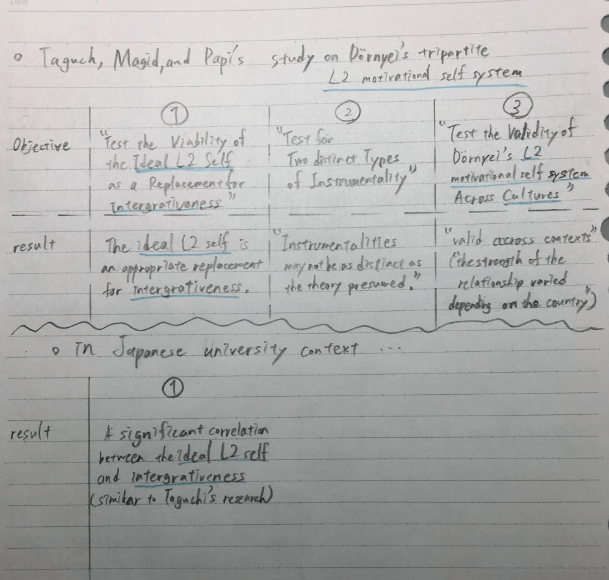
Please read and take notes on pages 5 to the first paragraph of page 12 of the article and enter the notes in your Google Doc for Class 04 by Tuesday, 1 p.m., before Class 05. We will read this study in the link below, which is the same as the poster, slowly over two classes, and this study is about University students’ motivation. Please take pictures of your notes and put them in the Class 04 Word document. You do not have to understand everything, and ask me questions anytime you have them.
Hughes, L. S., Vye, S., & Ray, D. (2020). The L2 motivational self system: A replication study. JALT Journal, 42(1), 5-28. https://jalt-publications.org/sites/default/files/pdf-article/jj2020a-art1.pdf
Note Taking Sample:

Class 03 L2 Motivation & Language Learning Experience

Summary: After discussing the ‘Art’ article, you spoke about your English past.
For the “Art” article questions:
- How did your English language learning experience compare to Maria, Fumi, Machio, or Sachi? Similar, different? Why or why not?
- What do you think about drawings? Some students feel comfortable drawing, and some do not. How about you?
- How were the Art students similar or different from Professor Irie’s narrative study students?
English Past (Language Learning Experience and Ought-to Self):
- When did you start learning English? Please discuss what you remember about this experience. About how old were you?
- How did you study English in junior and senior high school? How were your English classes?
- Pretend I were a student in one of your classes in secondary school. Please take me to the class and describe what I would see.
- What English studies did you feel you had to do, but did not want to do?
- Describe a positive(s) or negative experience(s) you have had learning English in the classroom. What did you learn from the experience?
- What was the best or worst English class you have ever had? Why?
- How about studying abroad? If so, how was it?
- Have you used English while abroad? In Japan? If so, how was that? Please explain.
- What opportunities have you had to use English outside the classroom?
Homework due on Tuesday by 1 p.m. before Class 04:
- Please take two or more pages of notes on Zoltan Dornyei’s talk about motivating students and teachers through imagination and vision to support your language learning goals.
Dornyei, Z. (2016, December 02). Motivating learners and teachers through vision [Video]. Youtube: Cambridge University Press. https://www.youtube.com/watch?v=jMTLYjLksvg
Note-Taking Sample of Dornyei’s Video:


2. Your Free Rice Learning Program
For your English motivation, you can choose any English category and study as you wish. You aim to get 4,000 correct answers before Class 15 at your pace, but do practice sometime every week. This is 20% of the class grade, but you can choose the subjects you wish and feed children worldwide hungry for free, sponsored by the United Nations and the World Food Programme.
Class 02 Definitions of the L2 Self System

Summary: We discussed the L2 Motivational Self System theory and the reading from Session 1, and we had the Poster session below:

Homework due next Tuesday at 1 p.m. before Class 03:
Please take notes on Dr. Irie’s video interview by hand. Then, please take photos of your notes and insert them in your Google Doc for Class 02. Make sure to use the “cc” icon in the lower right corner of the video. Pause the video as needed to do the note-taking work for you. If you write some sentences word for word, use quotation marks and write the time spoken in the video like (Irie & O’Neil, 2015, 01:19).
Irie, K. & O’Neil, T. (2015). Motivation in language learning with Professor Kay Irie, Gakushuin University, Tokyo [Video]. Youtube. https://www.youtube.com/watch?v=3iPqvC-q5fg&t=1s


2. Your Free Rice Learning Program
Please make an account for our ESP1a English Motivational SS with our class code if you have not already. Several students and I are playing already. You can create an avatar name, but please let me know your game name. You can choose any English category and study as you like for your English motivation. Your goal is to get 4,000 correct answers before the last class at your pace, but do practice sometime every week. This is 20% of the class grade, but you can choose the subjects you wish and feed children around the world who are hungry for free, sponsored by the United Nations and the World Food Programme:
Class 01 Orientation & the L2 Motivational Self System

Summary: We had an orientation about how to be successful and get the most out of this course to support your university studies and learning. To understand more about self-directed learning, we viewed and studied the ‘Learning Motivational Animation video:
BYU Center for Teaching and Learning. (2014, Feb. 1). Learning motivation animation [Video]. Youtube. https://www.youtube.com/watch?v=z8uEPA3OX5M
How will your grade be calculated?
Homework (30%)
Free Rice (10% Content, 10% Online Class Participation),
Midterm L2 Motivation Paper (20%),
L2 Motivation Final Presentation based on the paper (20%)
Class Participation (10%)
Class Documents

Homework due the day before Class 02 at 1 p.m.:
1. Done in Class 01: Please email me with a) a greeting, b) why you are taking this class, and c) what English classes you have taken at Saitama University. Then, I will reply and send you a link to your Google Doc Homework upload file.
2. Please read and take notes on this article for about 2-3 pages in the link below. Please take two photos and put them in the Google share file and the document I shared via email. I will explain this in class:
Vye, S. (2016). Art and the motivational L2 self system in a university course. Learning Learning, 23(2), 2-7. http://ld-sig.org/wp-content/uploads/2016/10/Article-1-Vye.pdf
Note-taking is an excellent skill to use while studying or in your daily life. There is no one correct way to take notes, but it is helpful not to write long sentences and to write the main idea in phrases and images. Here are some note-taking samples:
Note Taking Sample 1


Note Taking Sample 2


2. Your Free Rice Learning Program
Please make an account for our ESP1a Motivational SS (Self System) with the class code I provided in WEB CLASS if you have not already. Several students and I are playing already. You can make an avatar name if you wish, but please let me know your game name. You can choose any English category and study as you like for your English motivation. Your goal is to get 4,000 correct answers before the last class at your pace, but do practice sometime every week. This is 20% of the class grade, but you can choose the subjects you wish and feed children worldwide who are hungry for free, sponsored by the United Nations and the World Food Programme.
Class_07: Individual SDL Research

Summary: We discussed the alphabet of self-talk and growth mindsets from class 06, and you began to think about your topic for your self-directed learning report. The key is to write about something interesting to you!
Attachment: Self-directed Learning References
The homework is due at 13:00 on the day before Class_08:
1. You need time to work on the start of your paper slowly by researching two articles or videos of your choice that match your interest in your learning focus for your paper. It could be grit, growth mindsets, lifelong learning, computer-assisted learning, or something related to learning.
Here is the search engine Carrot for self-directed learning. You can read other articles for your paper and presentation.
Here are some excellent self-directed learning midterm reports and their corresponding final presentations to help you think about what aspect of self-directed learning you would like to write and present.
Example A:
Life-Long Learning & Growth Mindsets Midterm Paper
Life-Long Learning & Growth Mindsets Final Presentation
Example B:
COVID-19 & Self-Directed Learning Midterm Paper
COVID-19 & Self-Directed Learning Final Presentation
2. Complete your three-question reflection in your Google Doc share file.
It’s beneficial to play Freerice.com during the winter break. This United Nations project website has 60 levels of English vocabulary to learn and develop. For each correct vocabulary word comprehended, Free Rice will donate 10 grains of rice through the World Food Programme to help end hunger, so students can learn new words and also contribute to reducing world hunger at the same time. And the levels of difficulty range from low to very high, so it is also suitable for teachers. There are also various subjects, including English Grammar and SAT Test Preparation. And amusingly, the site has a warning that claims this game may make the person smarter! http://freerice.com/#/englishvocabulary/1424
Your Free Rice goal for the semester is 4,000 points!
Session_15: Reflections

Summary: I hope you have a wonderful break and make good use of the time, and have fun too!